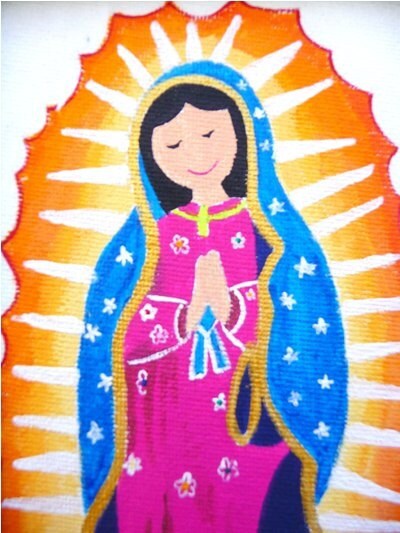
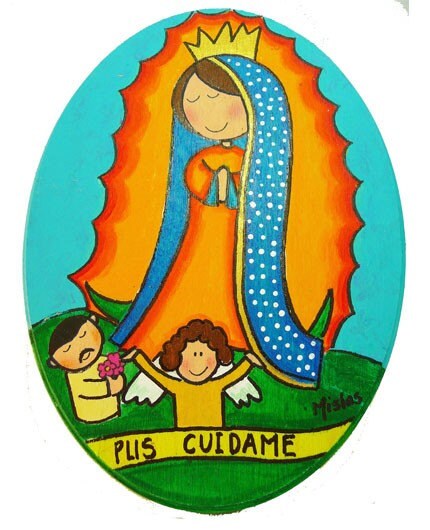
The Blessed Virgin appeared at Tepeyac, Mexico, Saint Juan Diego on Tuesday, December 12 1915, just ten years after the conquest of Mexico. The mother of God comes to present the gospel to its native sons of the new continent and to "show and give" all his "love and compassion, help and protection, because I am your merciful mother."
As proof of his visit made the Virgin miraculously appeared in the place beautiful roses of Castile and her image will stay permanently in the cloak of his servant.
The Virgin of Guadalupe to Juan Diego gave a careful treatment of the condition prophetically bringing nobility of all people . The Lord "down from their thrones and exalted the humble." Meanwhile, the Virgin brought reconciliation and not division among the natives and the Spanish. He helped them both to understand that Christian faith is not owned by anyone but a gift of love for everyone. The Virgin asked Juan Diego to go to the bishop. The Bishop of Mexico was Fray Juan de Zumarraga , a Franciscan. In this way the Virgin teaches that one must submit to the legitimate authority in the Church Jesus established.
Four years passed so the Western culture recognize that the printed image on indigenous ayate was a true Mexican codex, a message from heaven full of symbols. Helen Behrens, an American anthropologist discovered in 1945 what the eyes of the Indians had "read" the painting of the "Mother of the true God for whom we live" that December of 1531.
She is so important now in our culture, thousands of pilgrims visit the Basilic on this date, to thanks her all the miracles she made, to take care of us and for love us as the Great Mother she is. Her image for me is so innocent and pure and the real painting is still a complete mistery for scientists.
The first thing that catches the attention of textile experts is that ayate fabric on which is the image of the Virgin is maguey plant fiber. By its nature, this fiber is decomposed by putrefaction in twenty years or less. This has happened with several reproductions of the image that have been manufactured with the same tissue. However the image ayate has withstood over 470 years in perfect condition. For reasons incomprehensible to experts, the image ayate is refractory to moisture and dust.
The image of the Virgin of Guadalupe was 116 years exposed to the harsh environment, without protection against dust, moisture, heat, smoke from the candles and the continuous rubbing of thousands and thousands of objects that were touched to venerated image, as well as constant contact and kissing hands of countless pilgrims. All this without any frayed or faded his beautiful polychrome.
And the most amazing thing is the enigma of her eyes. Although its dimensions are microscopic, the iris and the pupils of the eyes of the image are printed at least highly detailed image of thirteen characters. The same people are present in the left eye or right, with different proportions, as is the case in the eyes of a human being that reflects the objects you have in front.
The reflection transmitted through the eyes of the Virgin of Guadalupe is the scene in which Juan Diego showed the Bishop Fray Juan de Zumarraga and stay present in the mantle with the mysterious image. It was the December 9, 1931.
According to the findings of the study, revealed by a Zenit Tonsmann Aste, during a visit to Rome in early January, we face an image "that has not been painted with human hands."
g the canvas is another mystery. The Ger a Nobel laureate in chemistry, has studied this painting, and his response stunned the audience: "These colors are neither mineral, or vegetable or animal." They could not explain the origin of the pigments that give the image color or the way in which this was painted.